Opportunity: the story
Opportunity
Mars Exploration Rover B · 2003 – 2019
Built to last 90 Martian days and drive 1 km. This is the story of the almost 15 years it actually worked on Mars.
Follow the water
Why it was built
Life as we know it needs liquid water. NASA sent twin rovers, Spirit and Opportunity, to opposite sides of Mars to search rocks and soil for clues of past water, at places where conditions may once have been favorable for life.
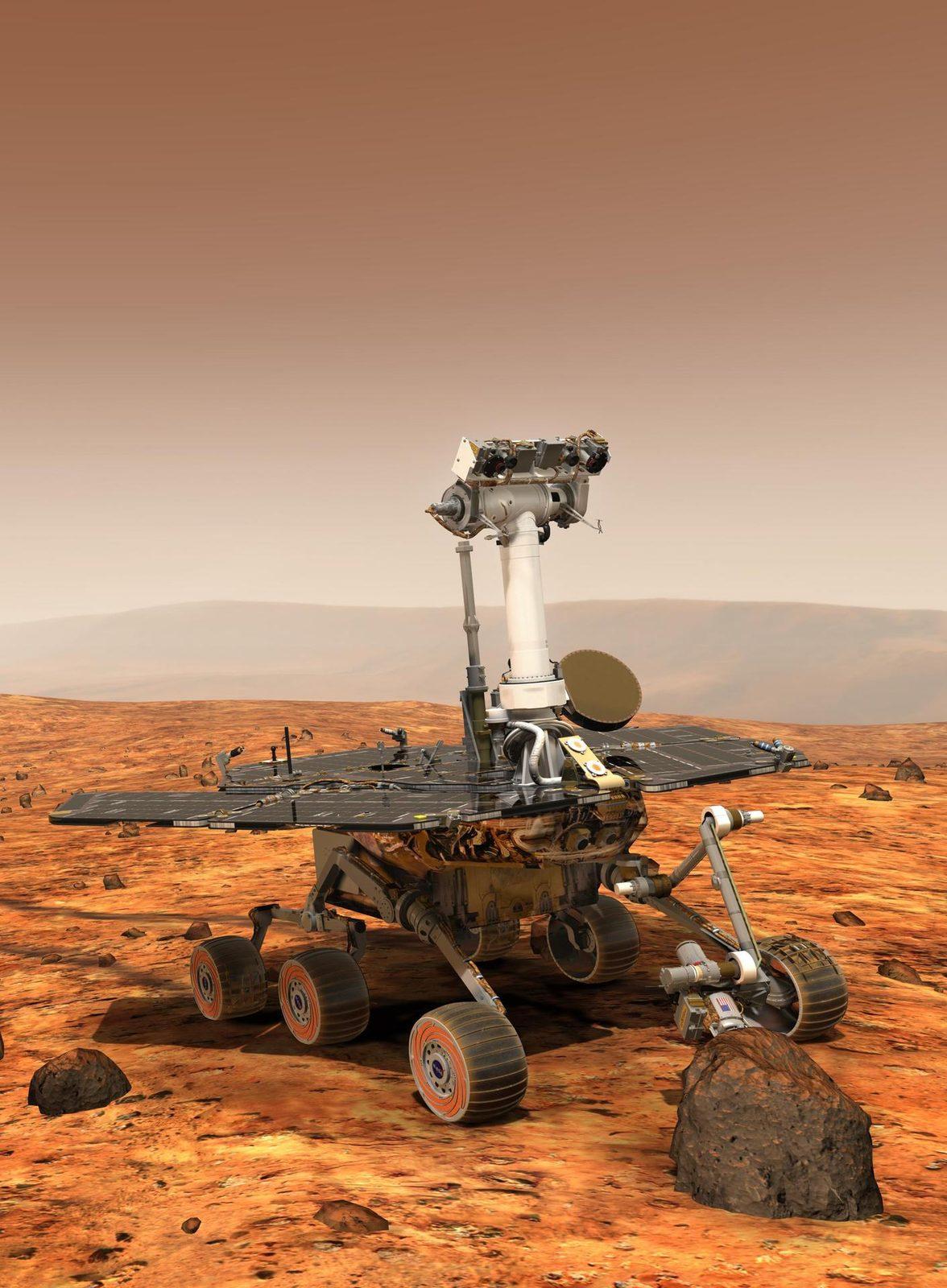
A geologist on wheels
Jet Propulsion Laboratory, 2003
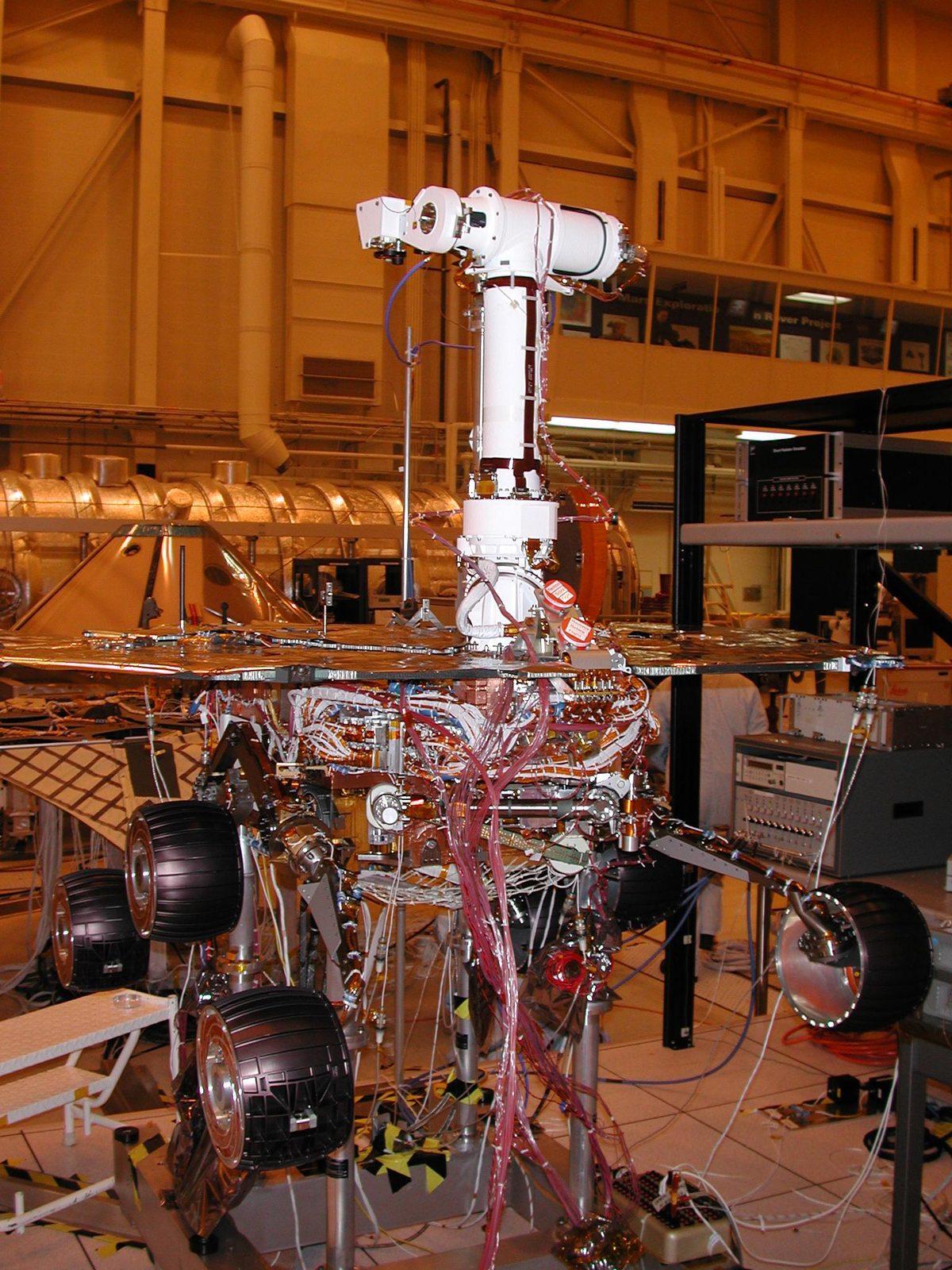
About the size of a golf cart, with cameras on a mast about 1.5 m off the ground and a robotic arm carrying a microscope, two spectrometers, magnets and a rock grinder.
Folded for the trip
Kennedy Space Center, May 2003
Engineers folded it inside a lander and fitted airbags around the outside. Its name was still MER-1; it would fly as MER-B.
Liftoff
7 July 2003 · 23:18 EDT
A Delta II Heavy rocket carried it off Space Launch Complex 17B at Cape Canaveral, Florida.
Six months in the dark
July 2003 – January 2004
It crossed to Mars in about six and a half months. After a final course correction on 16 January 2004, it dived into the Martian atmosphere.
Bounce
25 January 2004 · 04:54 UTC
Wrapped in airbags, it hit the ground and bounced at least 26 times across the plain of Meridiani Planum.
A crater 22 m wide
Eagle crater
It rolled to a stop inside a small crater called Eagle, 14.9 km from its target. The landing platform it left behind is still there, seen here from orbit in 2017.
Blueberries
Eagle crater, 2004
Tiny spheres of hematite, a mineral that forms in water, covered the ground. Layered bedrock told the same story: liquid water once soaked these rocks.
Twice the warranty
26 July 2004 · sol 180
It climbed out of Eagle on 22 March and drove to Endurance crater, about 750 m away. On sol 180, double its 90-sol mission, it photographed its own shadow on the way in.
A visitor from space
January 2005
Near its own discarded heat shield it found a basketball-sized rock that turned out to be an iron-nickel meteorite.
Six weeks in the sand
2005
On 20 March 2005 it set a one-day driving record: 220 m. Later that year a sand ripple buried its wheels. Drivers at JPL freed it a few centimetres at a time, and in June, six weeks later, it rolled out.
Victoria
September 2006
After a 21-month trip it reached Victoria crater, about 800 m wide, wider and deeper than anything either rover had examined. Look closely at the rim: that dot is Opportunity, photographed from orbit.
The view from the rim
Cape Verde, Victoria crater
It worked its way along the scalloped rim, photographing cliffs of layered rock from promontories like Cape Verde.
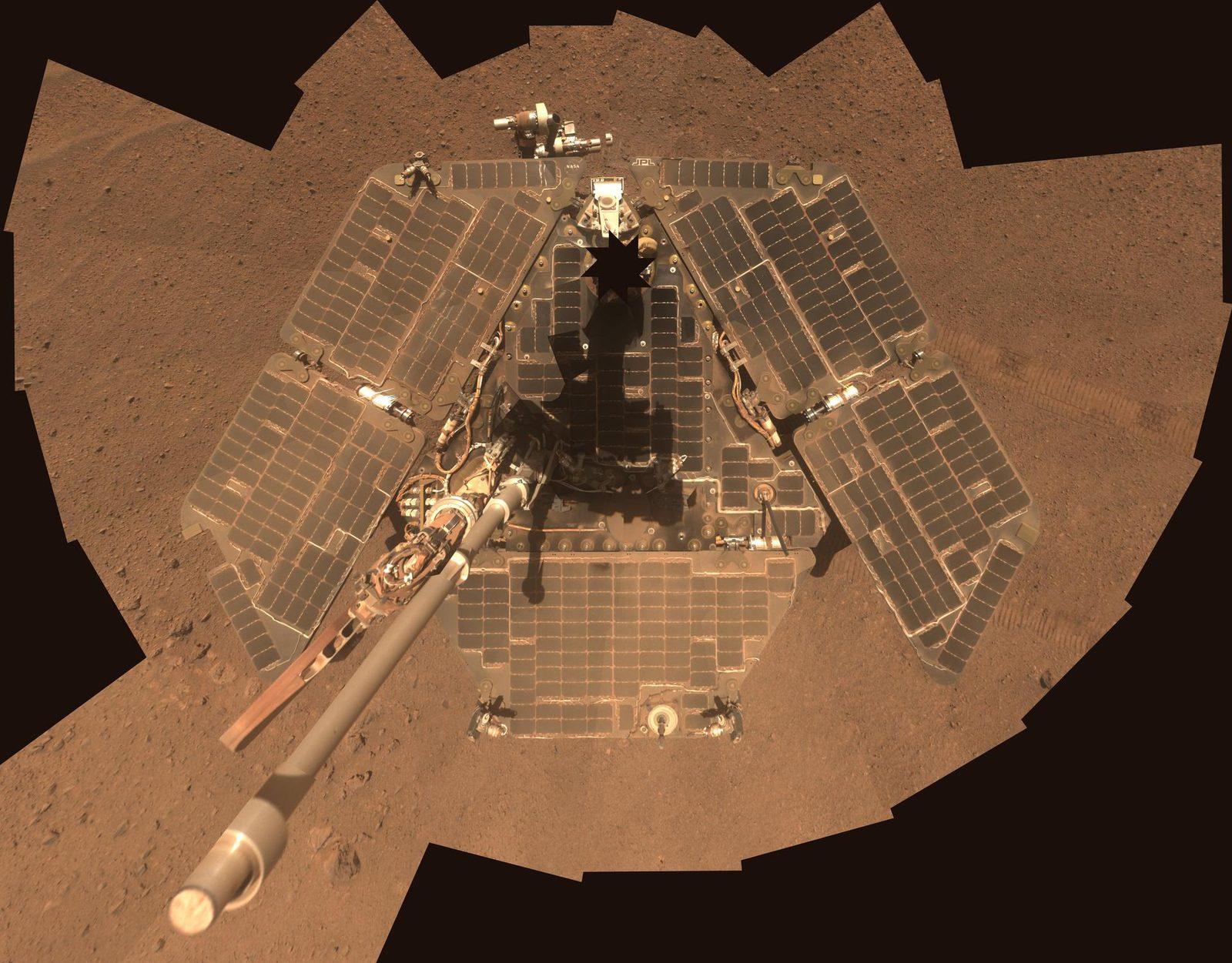
The first storm
18 July 2007
Dust storms darkened the sky. Its solar panels were down to 128 watt-hours, the lowest for either rover. Science stopped. About six weeks later the dust settled, and on 11 September it drove into Victoria, staying almost a year.
The long road
2008 – 2011
Next: Endeavour crater, 22 km wide, its rim just visible on the horizon. On 20 May 2010 it passed Viking 1's record for the longest working life on the surface of Mars, 6 years and 116 days.
Endeavour
9 August 2011
After nearly three years and about 21 km, it reached the rim at a spot called Spirit Point. Here it found strong signs of ancient water similar to the drinkable water of a pond or lake on Earth.
Homestake
December 2011
A bright vein rich in calcium and sulfur, possibly the mineral gypsum, filling a crack in the rock.
Farther than anyone
2013 – 2014
On 16 May 2013 it passed the Apollo 17 lunar rover's 35.744 km, the NASA record for driving on another world. On 28 July 2014 its odometer read 40.25 km, past the 39 km credited to the Soviet Lunokhod 2 (later Russian analysis suggests Lunokhod 2 may have driven 42 km).
A marathon on Mars
24 March 2015 · sol 3,968
A 46.5 m drive took its total to 42.198 km, past the 42.195 km of an Olympic marathon. No human enterprise had gone that far on another world.
Thirty-two degrees
March 2016
On 10 March it drove at a tilt of 32 degrees, the steepest slope any rover had driven on Mars. On 31 March, sol 4,332, it watched a dust devil twist through the valley below.
Perseverance Valley
2017
It reached a gully cut into Endeavour's western rim, about two football fields long, and began to drive down it. On 4 June its left front wheel stalled, turned out 33 degrees.
The storm
1 – 6 June 2018
Orbiters spotted a dust storm on 1 June 2018. By 6 June it had covered Opportunity's corner of Mars (the blue dot), and it went on to blanket the planet.
Darkness
June 2018
The Sun shrank to a pinprick. This simulation shows Opportunity's sky as the dust thickened, from a bright afternoon to a Sun so dim it looks like a pinprick. For a solar-powered rover, that meant almost no power.
Last signal
10 June 2018
Its final communication arrived on 10 June 2018. Then, silence.
Listening
June 2018 – February 2019
For eight months, engineers at JPL sent more than a thousand commands and listened for any reply. Their last attempt went out on 12 February 2019.
Its last panorama
13 May – 10 June 2018
354 images, taken in its final month. Its tracks lead down into Perseverance Valley, where it rests today.
Mission complete
13 February 2019
Planned: 90 Martian days and 1 km. Delivered: 60 times the life expectancy, 45.16 km and more than 217,000 images.
The end
Thank you, Opportunity.
Sources
Every photo is from NASA's public archive and credited on screen; the cruise and silence scenes are drawn, and the bouncing path is an illustration, not to scale. NASA does not endorse this site.