Chapter 4 of 5

The X-ray Moon

Crust thickness, porosity and buried magma dikes from GRAIL gravity

Told in GRAIL’s imagined voice · the events are real · source
CAPE CANAVERAL, Fla.
GRAILOur map was not a photograph.
NASA/Jim Grossmann
01PIA16587 shows the Moon’s gravity field as measured by GRAIL. Red and blue areas mark where gravity is stronger or weaker than average. Surface cameras cannot see those hidden differences directly.
The crust turned out thinner.
02GRAIL results pointed to an average lunar crust of about 34 to 43 kilometres thick. That is thinner than many earlier estimates, and it helped scientists test ideas about how the Moon formed and cooled.
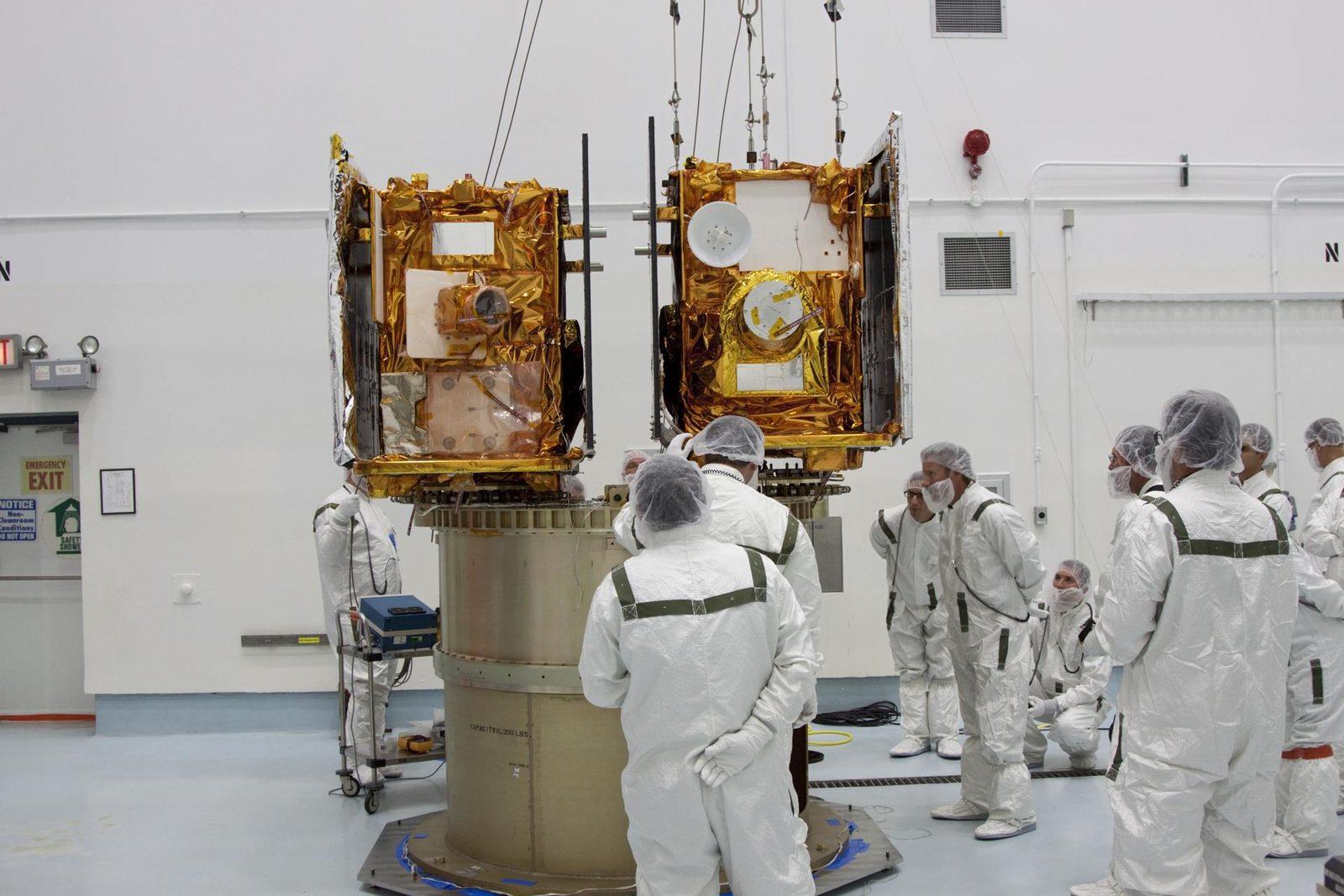
NASA twin Gravity Recovery and Interior Laboratory GRAIL spacecraft are lowered onto the second stage of their Delta II launch vehicle.
GRAILThe highlands were more like a sponge.
NASA/JPL-Caltech/KSC
03A separate GRAIL product, PIA16588, depicts porosity in the lunar highland crust. The number matters because it says the upper crust is fractured and contains pore space, not one solid slab of rock.
Buried cracks held old lava.
04Gravity signatures also revealed long, buried features interpreted as ancient magma dikes — cracks filled with lava long ago. They were invisible in ordinary surface pictures, which is why a gravity X-ray was needed.

The big idea

Gravity maps can reveal crust thickness, pore space and buried lava features that ordinary cameras cannot see.

Think about it

How can a map made from motion reveal the thickness of rock?

Fact file

Gravity-field map
PIA16587
NASA’s image is the lunar gravity field; far side centered in Mercator view.
Source ↗
Porosity image
PIA16588
PIA16588 depicts highland-crust porosity, not crust thickness.
Source ↗
Average crust thickness
34 to 43 km
Used here as a GRAIL-reported range; the prior Apollo-era estimate and Giant Impact interpretation are described cautiously, not as proof.
Source ↗

In this chapter: LGRS range-rate time series, gravity-field models and topography comparison

Sources: Main record · PIA16588 · NASA Image Library · PIA16600 · NASA Image Library

Machine illustration: AI-made. Photos: NASA Image and Video Library, credited on each picture.

Chapter 4 of 5

Next