Chapter 4 of 5
Seventeen minutes of pictures
Ranger 7 transmits the first close-up images of the Moon by a U.S. spacecraft
Told in Ranger 7’s imagined voice · the events are real · source
The big idea
A series of images at increasing resolution can turn a distant, fuzzy world into a place with measurable features.
Think about it
Why would scientists want both wide views and close-up views of the same surface?
Fact file
- First image
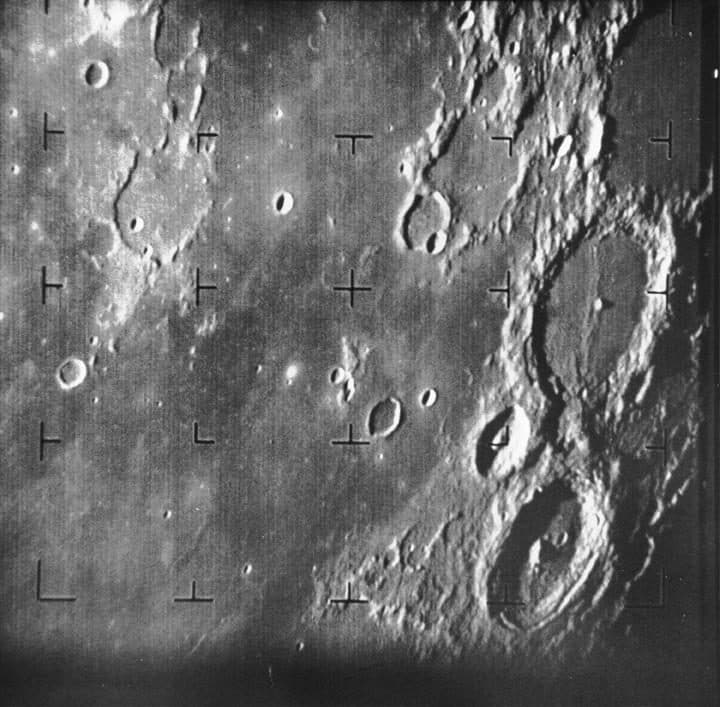
- 13:08:45 UTC · 2,110 km altitude
- The wide-angle F-a camera returned a view that included the 108-km crater Alphonsus.
- Source ↗
- Picture total
- 4,308 photographs in about 17 minutes
- NASA History and NSSDCA list 4,308. NASA Science's short mission overview sometimes gives 4,316; this book uses the archive and history figure.
- Source ↗
- Final full frame
- About 2.3 seconds before impact · 1,600 ft
- NASA History describes detail down to about 15 inches. NSSDCA lists the final image resolution as 0.5 m, a slightly different measure.
- Source ↗
- Television downlink
- Channel F 959.52 MHz · Channel P 960.05 MHz · 60 W each
- A separate 3 W transponder used 960.58 MHz. The two TV channels had independent power supplies, timers and transmitters.
- Source ↗
In this chapter: Six RCA Vidicon cameras, two television channels and the Goldstone receiving stations
Sources: Main record · NASA · First image of the Moon from a U.S. spacecraft (PIA02975) · NASA · Guericke Crater from Ranger 7 (PIA02974) · LPI · Ranger 7 photographic archive · NSSDCA · Ranger 7 television experiment
Machine illustration: AI-made. Photos: NASA Image and Video Library, credited on each picture.